Methodology
EINSTEIN is based on a structured approach for the assessment and optimisation of energy systems
The basic pillars on which the EINSTEIN methodology is built are:
-
quantity and quality: the importance of temperature level (exergy)
A breakdown by temperature levels of both energy demand and residual energy is the crucial basic information as a starting point for exergy optimisation of supply (e.g. heat pump application or heat exchanger networks).
EINSTEIN provides a standard for the accountancy of energy flows in a project, including a system of definitions of quantities, subsystem boundaries and temperature levels.
-
critical environmental assessment beyond green-house-gas emissions only
The most urgent environmental concern on a short term remains the reduction of green house gas emissions. Nevertheless, the necessary large scale deployment of RES also has an important environmental impact. In many regions social movements are already forming (wind parks, large scale PV, high-voltage grids etc.) which are not willing to accept that there is no alternative to chosing between the big evil (fossil fuels) and another, even if comparatively smaller one (huge RES projects). Therefore, demand reduction and an assessment of the impact of RES use and it’s minimisation is required also for a mid-term scenario (hopefully arriving soon) where all energy sources will be renewable (with zero GHG emissions) and the technology choices necessary for this purpose. Furthermore, nuclear energy, in spite of having (almost) zero GHG emissions, in our opinion has no place in a future path to a sustainable energy supply, even not in first place due to the high associated risks (Tschernobyl, Fukushima), but still more due to the non-resolvable problem of keeping nuclear waste securely separated from the biosphere during several centuries.
In this context EINSTEIN provides:
- a sketch of a methodology for quantitative comparison of different RES systems
- a methodology for correcting GHG emission data in scenarios where nuclear energy is still part of the energy-mix
-
costs and benefits for whom ? common good vs. private profit in economic assessment
The outcome of any type of economic analysis depends strongly on basic a priori assumptions and optimisation targets: costs and benefits for whom – for a (private or public) investor or for the common good ? if the latter case, on a local or a global level ? Almost every investment in energy saving or energy optimisation is based on substitution of current spending (purchase of energy) by investment (mainly in energy efficient equipment). Therefore, the expectation on return of investment, is crucial for assessing the economic feasibility of projects. Beyond this, in an analysis concerned with the common good, the trade-off between economy, social and environmental impact has to be taken into account.
EINSTEIN provides a standard for economic analysis, that provides transparency and awareness about the critical input parameters and optimisation targets and their impact on the assessment results.
-
structured approach for optimisation
Although system optimisation is a complex task requiring an optimum combination of different technologies and concepts. good results can be obtained in an efficient way by applying a hierarchically structured approach for energy system optimisation as outlined by the „EINSTEIN’s eye“, followed by an iterative fine-tuning process based on dynamic system simulation.
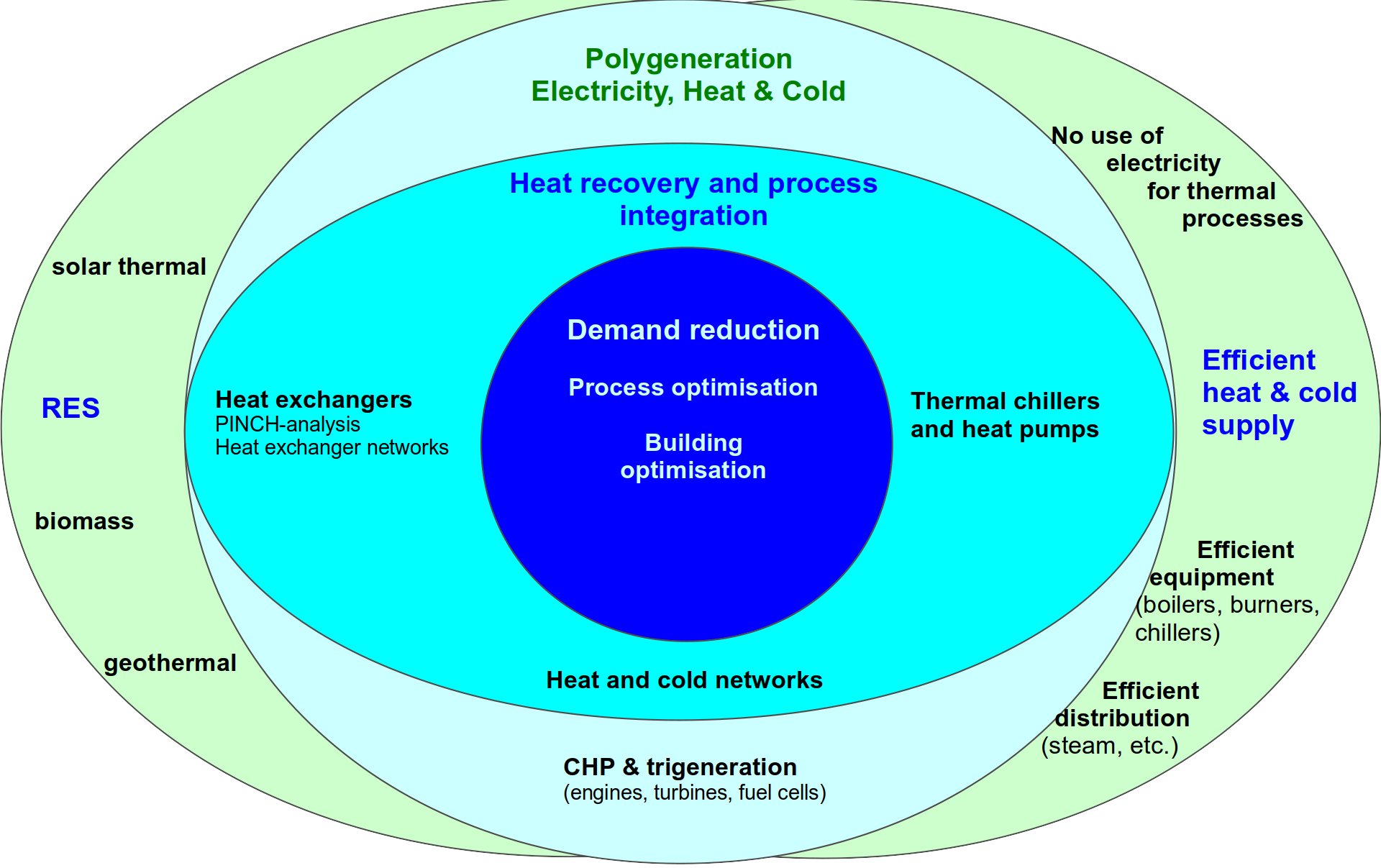
EINSTEIN’s eye: hierarchically structured approach for energy system optimisation (to be followed from center to periphery)
The EINSTEIN methodology as developed within several R&D projects until 2012 is described in detail in the EINSTEIN Guide for Thermal Energy Audits. An updated version of this guide reflecting the developments since then and the methodology as outlined above is currently under work and will be published soon as EINSTEIN Guide for thermal energy optimisation.